
How often should you review your rebuild costs?

Updated: Jul 30
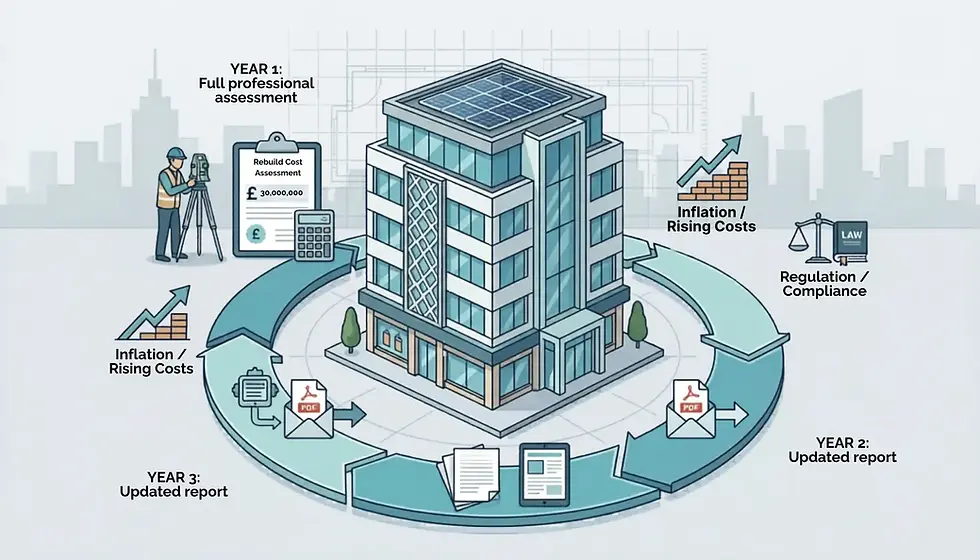
Rebuild cost accuracy isn’t a one-time exercise. In 2026, with construction costs still elevated and subject to change, the question property owners and brokers are asking is: how often should you review your rebuild cost assessment?
“Rebuild values are dynamic,” said Sharon Masters, AIIRSM MARLA TechCIOB, Technical Lead and Surveyor at RebuildCostASSESSMENT.com. “They don’t just move with inflation alone. They can also change with regulation, labour trends, and technology.”
A practical review cycle for many properties is a full professional Rebuild Cost Assessment every three years, supported by annual desktop reviews and earlier reassessment where there has been a material change to the building, its use,
regulation, specification or local reinstatement costs.
Not sure whether a desktop or site assessment is right for your property? Read our guide.
This cycle helps keep sums insured aligned with current reinstatement conditions, regional cost variations, and regulatory obligations and compliance requirements. These may include higher-risk building duties under the Building Safety Act regime, where applicable, and EPC/MEES-related energy efficiency requirements or proposed changes where they apply.
BCIS data shows how sharply reinstatement costs have shifted in recent years. Its BCIS/ABI House Rebuilding Cost Index was 42.6% higher in October 2024 than in January 2020. Although this measure relates specifically to residential rebuilding costs, the broader message is relevant across the property market: reinstatement values have changed significantly, so older sums insured may no longer be a reliable basis for cover.
Consumer Duty strengthens the need for evidence
For retail customers, the FCA’s Consumer Duty increases the importance of evidencing customer outcomes, including whether products and services provide fair value and meet customer needs. For commercial clients, the same practical issue remains: old or unverified sums insured can weaken the broker’s audit trail and make advice harder to support.
“An RCA from five years ago may still exist on paper, but if costs, specification or regulation have moved on, it may be difficult to defend as current evidence,” Sharon added. “Fair value is easier to evidence when the assessment is current.”
For portfolio owners, a rolling review strategy helps prevent all properties being due for reassessment at the same time, balancing accuracy with efficiency. Digital record-keeping and consistent RCA data across sites also make renewals faster and more defensible.
The frequency of review comes down to risk tolerance and exposure. For many properties, a three-year full assessment cycle is a sensible baseline. Higher-value, complex, listed, heavily altered, high-rise, mixed-use or regulatory-sensitive buildings may justify a two-year cycle or an earlier review.
Online calculators may seem tempting for a quick answer but should not replace a professional assessment for complex, high-value or non-standard buildings.
The aim is not to push sums insured upwards. It is to keep them evidence-based, reducing the risk of both underinsurance and unnecessary overinsurance.
Regular reviews support client evidence, protect against surprise shortfalls, reduce dispute potential, and help owners maintain confidence that their buildings insurance more closely reflects current reinstatement exposure.
When did you last review your rebuild cost?
If your rebuild cost assessment is more than three years old, or if your property has changed significantly since it was last reviewed, now may be the right time to check whether your buildings sum insured still reflects current reinstatement costs.
RebuildCostASSESSMENT.com provides professional rebuild cost assessments for residential, commercial and high-value properties, helping property owners, brokers and portfolio managers make more informed insurance decisions.
OR


